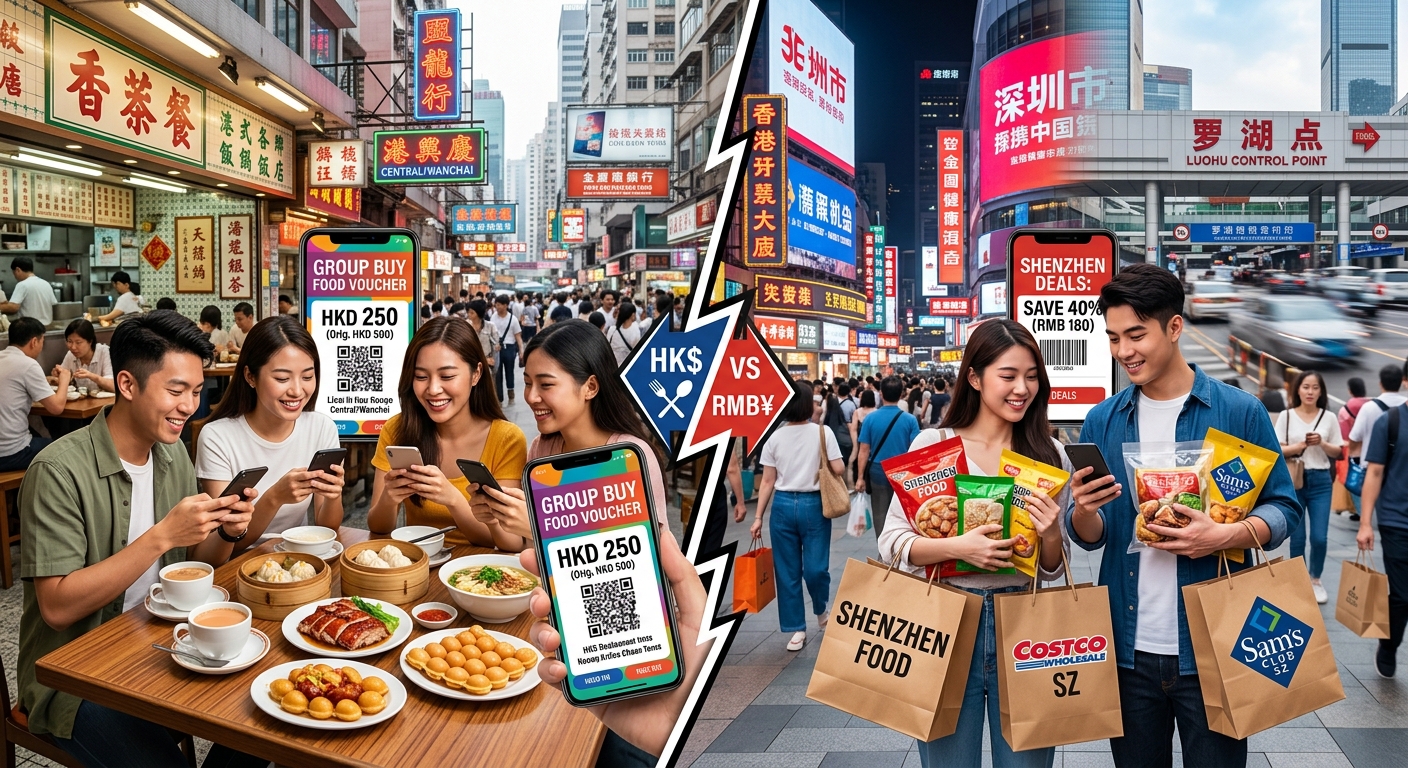
You open Meituan HK and spot a hotpot voucher at 38% off. Then you hop to Taobao Fresh and see what looks like an even bigger discount on the same brand's seasoning packets. At that point, most people freeze. Both look cheap. Both feel like wins. But these two channels work in completely different ways, and picking the wrong one for the wrong item can cost you more than buying full price at the supermarket.
Deal Framework
Local group-buy vouchers and cross-border food orders are built for different situations, and treating them as interchangeable is the most common reason Hong Kong shoppers end up overpaying.
- Local vouchers are fast and friction-free but carry genuine expiry risk if you buy more than you can realistically redeem within the window.
- Cross-border food orders on Taobao Fresh or JD's food section often look cheaper at first glance, but shipping fees and minimum order thresholds can close the gap entirely.
- Checking where Hong Kong food prices sit against other markets gives you a realistic anchor before committing to a bulk voucher purchase or a cross-border food haul.
How Local Group-Buy Food Vouchers Actually Work
Platforms like OpenRice Deals and Meituan HK sell prepaid vouchers that give you access to a restaurant meal, a bakery bundle, or a branded food product at a fixed discount. You pay upfront. You redeem later, usually in person or through the restaurant's own delivery channel. No customs declarations. No waiting days on a courier from across the border. No unpacking a box of styrofoam to find your soy sauce cracked in transit.
The appeal is obvious. You lock in a guaranteed price on something you were probably going to buy anyway. The discount is real and the transaction is clean. Hong Kong's group-buy food voucher market has matured significantly, with OpenRice Deals covering everything from family-style Cantonese restaurants to premium Japanese omakase sets. Meituan HK adds genuine competition that keeps discounts honest rather than artificially inflated.
But there is a structural weakness baked right into the model: the expiry date. Every voucher carries one, and that countdown starts the moment you pay, not the moment you feel like eating out.
What Cross-Border Food Shopping on Taobao and JD Actually Involves
Taobao Fresh and JD's food section operate on a completely different logic. You are buying physical goods, not a dining experience. The categories that make sense for cross-border food purchases are packaged snacks, condiments, health supplements, dried goods, and specialty ingredients that Hong Kong supermarkets either do not stock or price at a sharp premium.
Fresh produce and chilled items are generally impractical for cross-border shipping unless the seller uses dedicated cold-chain logistics, which adds cost and delivery time. Most Hong Kong cross-border food shoppers stick to shelf-stable products for this reason.
Before placing any food order from mainland platforms, it is worth knowing that Hong Kong's food safety requirements apply to items brought in for personal consumption, and certain categories, including meat, poultry, and some dairy products, require permits even in personal quantities. That is not a reason to avoid cross-border food shopping. It is a reason to check what you are ordering before the parcel ships.
Breaking Down the True Cost of Each Channel
The sticker price is the least useful number in this comparison. The only figure that matters is your landed cost per unit, which means what you actually paid divided by what you actually got to use or consume. A 35% discount that disappears into shipping fees and an unused bulk minimum is not a 35% saving.
Where Each Channel Stands on the Key Variables
| Channel | Typical Discount | Min. Order | Delivery Time | Expiry Risk | Import Friction |
|---|---|---|---|---|---|
| OpenRice Deals / Meituan HK | 20% to 50% | None (per voucher) | Instant (digital) | Medium to high | None |
| Taobao Fresh | 10% to 35% | HK$150 to HK$250 | 3 to 7 days | Low (shelf-stable items) | Low to medium |
| JD's Food Section | 15% to 40% | HK$200 to HK$350 | 3 to 5 days | Low (shelf-stable items) | Low to medium |
The table makes the structural difference clear. Local vouchers carry no minimum order requirement, which means you are not forced to buy more than you actually need. Cross-border platforms have minimum thresholds, and those thresholds push you toward bulk purchases that may sit unopened for months.
Grounding Your Comparison in Real Price Data
Before deciding whether a cross-border food deal is worth the shipping overhead, you need a realistic sense of whether Hong Kong food prices are genuinely inflated relative to the source market, or whether the gap is narrower than it looks. Many shoppers assume the gap is always large. It is not. Running benchmark items through a country price comparison tool before committing to a bulk order can tell you within minutes whether the expected savings are real or mostly absorbed by logistics costs.
For some product categories, Hong Kong prices are already competitive because of established import networks and supermarket rivalry. For others, including certain health foods, specialty sauces, and popular mainland snack brands, the gap is wide enough that cross-border shopping makes obvious financial sense. Knowing which category your item falls into before placing the order is the step most shoppers skip entirely.
The Items That Suit Each Channel Best
Cross-border food orders on Taobao Fresh or JD make the most sense in these situations:
- Specialty condiments or sauces sold at a steep Hong Kong premium, where you can comfortably use the full quantity before the product expires.
- Branded health supplements or TCM ingredients with a confirmed and significant price gap between mainland and Hong Kong retail.
- Pantry staples you cycle through regularly, such as noodles, rice vinegar, or dried mushrooms, where bulk buying genuinely reduces your per-unit cost without leaving you with waste.
- Popular mainland snack brands that carry heavy mark-ups in Hong Kong convenience stores or specialty import shops.
Local group-buy vouchers suit dining occasions you can plan and commit to within the validity window, one-off food gifts, and restaurant meals you were already going to book. They require no storage, no border logistics, and no minimum spend calculation.
Expiry Dates Are Where Good Deals Turn Bad
This point deserves its own section because it is the most consistent source of buyer regret in Hong Kong's voucher market. A dining voucher discounted at 40% is not a 40% saving if you let it expire unused. The actual cost in that scenario is 100% of the purchase price for nothing in return.
The math is unforgiving. If you buy five HK$120 restaurant vouchers as part of a group promotion, you spend HK$600 upfront. If your dining schedule only supports three of those within the validity window, you have paid HK$600 for three meals. That shifts your effective discount dramatically and may reverse it entirely when compared to dining at full price with a credit card cashback offer.
Meituan HK vouchers typically carry 30 to 90 day windows. OpenRice Deals varies by vendor. Some promotional group buys stretch to six months, but the more aggressive the discount, the shorter the window tends to be. Track your personal redemption rate honestly before buying in bulk.
One Habit That Prevents Voucher Waste
Keep all your active vouchers in one place, whether that is a folder in your email, a dedicated note on your phone, or the platform app itself. Set a calendar reminder two weeks before each expiry date. Two weeks gives you enough time to either use the voucher or pass it to a family member or colleague who will. Gifting an expiring voucher is always better than letting it lapse.
Shipping Costs Are the Hidden Tax on Cross-Border Savings
SF Express cross-border shipping from mainland China to Hong Kong runs roughly HK$15 to HK$30 per kilogram for standard parcels, depending on the seller's logistics arrangement. A mixed box of snacks and condiments weighing three kilograms adds HK$45 to HK$90 to your total before you account for any platform service fees.
Many sellers on Taobao and JD offer free shipping above a threshold, but that threshold itself pressures you to buy more than planned. The question is whether the extra volume reflects what you will genuinely use. Buying twice as much to unlock free shipping on a product with a long shelf life makes sense. Doing it on something you are trying for the first time is a gamble with no easy way out.
JD's food section generally delivers more consistent logistics quality than Taobao Fresh, which relies on a wide range of third-party sellers with variable fulfilment standards. If you are ordering anything that requires careful packaging, such as glass condiment bottles or powdered supplements, JD's own-operated warehouses are worth the slight price premium over a random Taobao storefront.
Making the Final Call Between the Counter and the Courier
The decision framework is simpler than it looks once you lay it out. Local group-buy vouchers are for dining occasions you can plan and honour within the voucher window. Cross-border food orders are for shelf-stable staples where the Hong Kong price gap is confirmed, the minimum order matches your actual consumption pattern, and you are comfortable with the wait.
Neither channel is universally better. They are tools with different cost profiles. A methodical Hong Kong deal hunter uses both and applies each to the category where it wins on landed cost. The biggest mistake is treating the headline discount percentage as the whole story. Add up the shipping. Measure the quantity against what you will actually use. Check the expiry window. Verify the price gap against real market data before you commit. That complete picture is the one that tells you where your money genuinely goes further.